
Trust Is a Conclusion, Not an Adjective
Key takeaways
- Replace each adjective on a mover's page with the artifact behind it. One that will not convert into a document or a number is decoration.
- A federal USDOT number sits in a public record anyone can search, which is why it is worth asking for before anything else.
- A company that names its limits shows you where its evidence ends. One that claims perfection has given you nothing to test.
- Count the claims you could verify by tonight against the ones you could not. That ratio is the most honest thing on the page.
- A rating is a summary of opinions, while a registration number has to agree with somebody else's records. That is the difference between a claim and a check.
Anyone can type "trusted"
A moving company that wants to be trusted should publish what a customer can check and the limits it is willing to state out loud. It should not expect the word "trusted" to do that work, because the word is free and the checking is not.
The customer's version of the problem is three browser tabs that read almost identically. Trusted. Reliable. Professional. Number one in the city. Every one of those words is as available to the company that earned it as to the company that did not, which leaves them as useless to you as an unexplained price.
How to tell whether a moving company's claims are real
Judge a moving company by what it can show you rather than by what it calls itself. A federal USDOT or MC number can be verified at the source by anyone; a superlative can be verified nowhere. Trust is a conclusion you draw from evidence you can check yourself.
Replace the adjective with the artifact
The fastest way to read a moving company's website is to replace each adjective with the artifact behind it.
"Licensed" becomes a registration number you can look up. "Insured" becomes a certificate with an insurer's name on it. "Trusted" becomes nothing at all: there is no artifact underneath it, only a conclusion the reader is expected to have reached already.
An adjective that will not convert is decoration. It might well be true. It is simply not evidence, because nothing in it separates the company that earned the word from the one that typed it.
"Trusted" tells you nothing about what happens when the elevator reservation falls through. A number you can look up at least tells you somebody outside the company keeps a record of this one.
Three objections that are not easy to dismiss
Three arguments cut against everything above, and each is better than a shrug.
- Reviews are evidence. Thousands of people describing their own moves is data, and refusing to count it because it arrives as a star rating is its own kind of blindness.
- Every business markets itself. Asking a company to drop the adjectives while its competitors keep them is asking it to be judged on a page nobody else is writing.
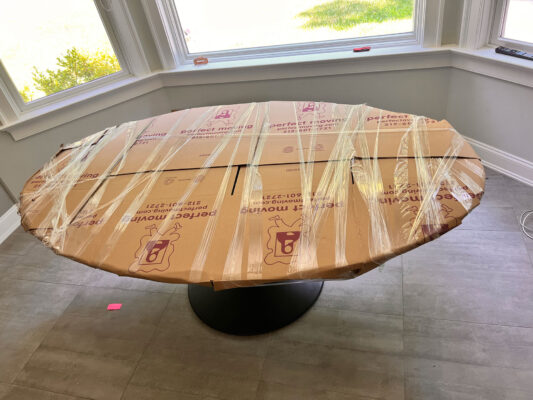
- Credentials are table stakes. A registration number shows a company is on a government list, not whether the crew wrapped your dining table.
The third is the objection I would make myself.
What a number can be checked against
The working difference between a rating and a registration number is that a registration number has to agree with somebody else's records.
A rating is a summary, and a summary is worth what you can see behind it: the platform, the review count, the period, what the critical ones describe. Without those, "highest-rated" is an adjective wearing a number as a costume.
Perfect Moving & Storage operates under USDOT 3222129, MC 1011174, and NYSDOT 40614. Look up the federal pair before you read another line of this.
USDOT and MC are the federal registrations covering a move across state lines; NYSDOT covers a move inside New York. The federal pair is verifiable through the Federal Motor Carrier Safety Administration's Safety and Fitness Electronic Records system.
That shows a company is registered and findable. It does not show that the crew at your door will be careful.
The sentences that cost something to say
A company's stated limits are worth more than its claimed perfection, because a limit is the one sentence a marketing page has no incentive to write.
Perfect Moving & Storage is fully licensed and insured, with additional insurance available through a third-party provider. That describes coverage. It is not a promise that nothing will ever be damaged, and a company happy to let you hear it that way has told you something about itself.
My father made me look up Perfect Moving's license number in the federal database before we signed anything. It matched. What won him over, though, was the estimator telling us plainly what they don't do, so he could see exactly where the promises stopped.
Michael D.
The same holds for what a company admits it cannot know yet: an elevator policy nobody has confirmed, a certificate of insurance an office has not returned. Naming those before you book gives you something to hold it to later.
Count what you could check by tonight
Every so often a customer opens the call with our USDOT number instead of a question. They looked it up before dialing, and the conversation starts somewhere better: not whether we are real, but how we would get a sleeper sofa down a prewar staircase with a turn in it.
The same habit works on any page, this one included: count the claims you could verify by tonight against the ones you could not. The ratio is the most honest thing on it.
It is also why you will not find a superlative about my company anywhere in this series. I cannot argue that adjectives are not evidence and then reach for one when it is my turn.
Frequently asked questions
How do I evaluate a moving company's marketing claims?
Replace each adjective with the artifact behind it and count what survives. "Licensed" should resolve into a registration number you can look up and "insured" into a certificate naming an insurer; "trusted" usually resolves into nothing.
What credentials should a legitimate NYC mover have?
Ask for the registrations that govern the move you are actually making: a federal USDOT and MC number for a move crossing state lines, and a New York State DOT number for a move inside the state. Then verify the federal pair at the source rather than accept it on the company's word.
What is a USDOT number and how do I check a mover's license?
A USDOT number is the federal registration number a moving company operates under, and it can be checked in public records through the Federal Motor Carrier Safety Administration's Safety and Fitness Electronic Records system rather than taken on the company's word. Perfect Moving & Storage operates under USDOT 3222129, MC 1011174, and NYSDOT 40614.
Are moving-company reviews and star ratings reliable?
A star rating is a summary, and it is only as reliable as what you can see behind it: the platform, the review count, the period covered, and what the critical reviews describe. A figure carrying those is something you can weigh; "highest-rated" carrying none of them is not.
What should a trustworthy moving company be able to show me?
Three things you can check without taking anyone's word: its registration numbers, proof that it carries insurance, and a plain statement of what it will not do or cannot know yet. The first two are records held outside the company; the third only gets written when a company means it.
Weigh the claims you can check
Adjectives are free, interchangeable, and written in an afternoon. The claims worth weighing are the ones that have to agree with a record kept somewhere outside the company's own website.
Want to run this test on us?
Start with the federal numbers in this piece and look them up. Then ask us what we will not take on for your move, or what we cannot know until a building confirms it, and see whether the answer is specific.
This is an opinion piece by Perfect Moving & Storage's President on how I believe a customer should read any moving company's claims, this one included. It is not legal advice, and which registrations govern your move depends on whether it is interstate (FMCSA) or intrastate New York.


This piece is drawn from the author's first-hand experience running Perfect Moving & Storage; no external study, statistic, or publication is cited. The company facts in it are its own: the registrations USDOT 3222129, MC 1011174, and NYSDOT 40614, the federal pair verifiable in public records at the Federal Motor Carrier Safety Administration, and a licensed-and-insured statement that describes coverage rather than guaranteeing an outcome.
Rock Katnic, Author. In 2019 Rock Katnic started Perfect Moving & Storage, and he still runs it as President. He started at the ground level more than a decade ago as a moving helper and worked nearly every job on the way up, from driver to dispatcher to general manager. He writes about how New Yorkers can move without the usual chaos.
Eddie Torr, Editor. Eddie Torr is an AI content editor who acts as the independent check on quality and compliance, and no draft advances until it clears him. He ties each claim back to its approved source, holds the piece to the editorial standards, and returns a ranked verdict. He does not rewrite the copy and does not approve publishing; a human reviewer makes that call.
Reed Marks, Reviewer. Reed Marks is a senior editor. Over nine years he has worked in copy editing, content review, fact-checking, and editorial QA in many different fields, and his degrees are in Journalism (bachelor's) and Professional Writing (master's). He gives each piece its final human read before it publishes: he checks that the claims stand, that the cited sources actually back them, and that the writing is clean and on-brand for search.
Reviewed on this post: He checked that the only company facts in the argument are its licensing registrations and its licensed-and-insured statement, both written as facts rather than as boasts, with the coverage statement separated from any promise of an outcome. He confirmed that no rating, review count, award, or superlative about this company appears anywhere in the piece.
Keep reading across the argument:
- What a price is really claiming
- Defining the boundary before publishing a number
- Publishing about a market versus serving it