
Your Move Is Decided by Choices You Never See a Crew Make
Key takeaways
- Under the visible lifting runs a stream of decisions: the route each item takes, what gets protected, what loads when, and when to stop.
- Load order is unload order. The sequence a truck is packed in decides what comes off first at the far end.
- A crew briefed before it arrives decides from the job's real facts. A crew told nothing improvises against a clock.
- Judge a crew by what it decides before it lifts. Those decisions are what you cannot get back once the truck has gone.
- A bad call rarely announces itself while the crew is still there. It shows up afterward as a gouged wall, a scratched floor, or a second trip.
What the crew decided before they lifted
Most of what decides how your move goes is settled before anybody picks up a box. Before the first item leaves your apartment, somebody has chosen the path it travels, what gets wrapped, the order the truck gets built in, and which problems are worth stopping for. You will not watch any of it happen, any more than you watched the thinking that turned into your price. You will only live with the result.
Strength and speed are what a customer sees from the doorway, so that is what crews get graded on. I think that is backwards. Judge a moving crew by the decisions it makes before it lifts anything. An industry that sells hours and bodies has every reason to dislike that standard, and I will argue for it anyway.
What movers are actually doing on move day
On move day a crew is making a continuous stream of decisions you rarely see: which route each item takes through the building, what gets padded or crated, what loads onto the truck in which order, and when to stop and solve a problem. At Perfect Moving & Storage the crew leader is briefed on those specifics before arriving.
The four decisions running under the lifting
A moving crew is running four decision streams at once, and none of them is about how much weight anybody can carry.
- Route. Every item has a path: out of the room, around the turn in the hallway, through the door frame, down the stairs or into the elevator, into the truck. The wrong pick is where floors and jambs get hurt.
- Protection. What gets padded, what gets wrapped, what earns a crate, and what travels as it is. It costs time, so it is a judgment about which pieces need it.
- Sequence. What goes on the truck, when, and where. The order decides whether the last piece fits, and what is reachable first at the other end.
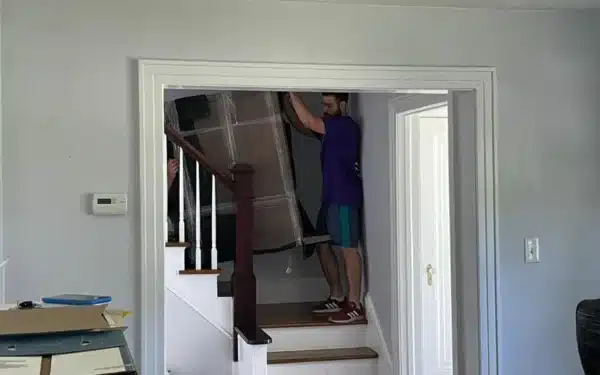
- Pause. When to stop a step that is not working and solve it rather than force it. A forced piece is how a bannister gets ruined in a stairwell where nobody is watching.
From the sidewalk, it does look like muscle
From the sidewalk a move looks exactly like the thing people say it is: strong people carrying heavy objects quickly. You pick a thing up and you put it down, so the variable that matters is how many strong people you have, and cheap crews do finish the same jobs.
Some of that lands. It is physical work, and a crew that cannot carry the load will fail however well it plans. What the cheap crew finished is the open question: a job can be completed and still cost you a refinished floor or a second trip nobody priced. Skipped decisions do not disappear, they get made badly.
First off the truck at the new place: the beds and the kids' boxes. Exactly what we needed that night. Someone had loaded it around our evening.
David P.
Load order is unload order
The sequence a truck is packed in is the sequence it comes apart in at the far end, which is why load order is the decision customers underestimate most. A truck built only to fill space is an expensive object to unpack.
The constraints at the destination are rarely a mirror of the ones you left. A narrow morning window on a freight elevator at the new building decides an entire day, and it has to be answered while the truck is still being loaded at the old address.
I watch this play out a few times a season. A crew leader knows before arriving that the destination building holds its elevator for a short window, so the truck gets built deliberately backwards: the bulky, elevator-dependent furniture goes on last, so it comes off first and clears the elevator inside the window.
Load for space alone instead and the window closes on cartons, with the afternoon spent walking a sofa up a staircase.
The last thing onto the truck is the first thing through your new door. Somebody decided that hours earlier, in a hallway you were not standing in.
Why a crew leader knows your building before the truck does
A crew makes better decisions when it arrives already knowing the facts that change them.
Before one of our crews arrives, the crew leader is briefed on the specifics that drive the calls on site: the confirmed access route and timing, the items flagged fragile or high value, the building constraints we know about, and the intended load sequence. That is the difference between deciding from the job's real facts and deciding from the first five minutes.
Improvising is not automatically wrong, but it is what you fall back on when nobody handed you the facts.
The cost of a bad call shows up after the truck leaves
A bad decision on a move rarely announces itself while the crew is still there. It shows up afterward as a gouged wall, a scratched floor, or a second trip.
No estimate carries a line that reads "thought about the sequence." So judge earlier: ask whoever quotes your move what the crew will be told before it arrives, and what the plan is for loading.
Frequently asked questions
What are movers actually doing on move day besides lifting?
Besides carrying, a crew is deciding: the path each item takes through the building, what gets padded or crated, the order the truck is loaded in, and when to stop a step that is not working. The deciding is what separates two crews on the same job.
How do movers decide the order to load a truck?
A truck is loaded around what has to come off first at the destination and what can safely bear weight. Heavy, flat, rigid pieces set the structure, and anything needed early at the new address goes on late so it comes off early.
How do professional movers protect furniture and floors?
Protection is decided item by item and surface by surface before anything moves: pads and stretch wrap on furniture, boxes or crates for fragile and high-value pieces, jamb and corner protection where a path turns, and coverings on floors that take traffic all day.
What decisions does a moving crew make that customers never see?
The decisions you never see are made before the crew arrives or out of the room you are standing in: how the job was briefed, how the truck is being built inside, which piece is being rewrapped in the stairwell, and which route was rejected.
Why does the same job go faster with a better crew?
A better crew is usually faster because it is not redoing things. Time on a move disappears into rework: an item re-wrapped, a truck restacked, a piece carried back down because it will not clear a turn.
The deciding is the job
Your move is carried by strength and settled by judgment. The route, the protection, the load order, and the willingness to stop are the parts you never watch, and they decide what arrives and in what condition.
A crew that arrives already knowing your building
If you are lining up a move, ask whoever quotes it what their crew will know before it pulls up. When you want ours, the crew leader gets the access route, the flagged items, the building constraints, and the intended load order before the truck does.
This is an opinion piece by Perfect Moving & Storage's President, describing how I believe a moving crew should make its decisions and the standard we hold our own crews to. It describes practice, not a promise about any individual move.


This piece is drawn from the author's first-hand experience running moving operations in New York City, and the operating practice described in it, the crew-leader job brief given before a crew arrives, is Perfect Moving & Storage's own. No external sources are cited.
Rock Katnic, Author. In 2019 Rock Katnic started Perfect Moving & Storage, and he still runs it as President. He started at the ground level more than a decade ago as a moving helper and worked nearly every job on the way up, from driver to dispatcher to general manager. He writes about how New Yorkers can move without the usual chaos.
Eddie Torr, Editor. Eddie Torr is an AI content editor who acts as the independent check on quality and compliance, and no draft advances until it clears him. He ties each claim back to its approved source, holds the piece to the editorial standards, and returns a ranked verdict. He does not rewrite the copy and does not approve publishing; a human reviewer makes that call.
Reed Marks, Reviewer. Reed Marks is a senior editor. Over nine years he has worked in copy editing, content review, fact-checking, and editorial QA in many different fields, and his degrees are in Journalism (bachelor's) and Professional Writing (master's). He gives each piece its final human read before it publishes: he checks that the claims stand, that the cited sources actually back them, and that the writing is clean and on-brand for search.
Reviewed on this post: He checked that the crew-leader briefing practice is written as standing practice rather than as a promise about any individual move, and that the load-order account reads as a recurring operating pattern with no invented customer, address, date, figure, or quotation. He confirmed that no damage, safety, or speed guarantee is claimed anywhere in the argument, that no competitor or peer company is named or implied, and that the reader is given a test they can apply to any moving crew, this one included.
Keep reading across the argument:
- The standard this whole series argues from
- Why stopping is the professional decision
- Why familiarity is not readiness