
From a Park Bench to Perfect Moving: What the Truck Taught Me
Key takeaways
- Start from where you are. I started from a park bench, and the work was still the work.
- Finish what you take on, to the end, decently and honestly, not halfway.
- The parts of a job nobody is watching are the parts worth doing properly.
- For me, stability comes first, before speed and before size.
My first night in New York was spent on a park bench. There were four of us, we had come on impulse, and we started from the very bottom. Most of what I argue about moving now, including why an unexplained estimate is the real warning sign, I learned after that night, on other people's trucks.
I learned moving from the ground up, and it shaped how I think about the work. A system still matters, and firsthand experience can help shape a practical approach to moving.
The first job
You can get into moving with nothing, which is exactly how I got in. The morning after that first night, we walked into a moving company's office and asked for work. We went on the word of a stranger, a girl none of us knew, who had told us to try there.
The answer was "come over", and that was the whole hiring process. There was no network to use. Today everybody is connected through social media; back then it was as if we had fallen from Mars.
The group we arrived with did not last. Somebody says "it cannot be done", one person is out, and the crew falls apart; by the end it was a friend from home and me, and on that first day there was practically no work.
What I did not expect was how well the work suited us. Once you are out in the field you take the truck, sign out the equipment and go move a client, and nobody is standing over you. On a construction site there is always someone telling you to do this, go there, bring that. The same in restaurants. Here we had a certain freedom, and one thing to get right.
"When you start from a bench, it's much easier. Carrying things is just a pastime."
Ten dollars for four days
What it cost, in plain numbers: we quit that first company, ran out of money, and had about ten dollars between the two of us for the next four days.
We ate because of a store near us. I picked up a bottle one night and the man at the register did not ring it up, because after midnight they threw that stock out rather than sell it. We exchanged a look, stepped out of the line and took everything we could carry. That was dinner, and it was how we got through the days that followed.
Not calling home was the one thing we would not do. We both thought of it as total failure, a fiasco, asking for help from New York.
"Neither of us dared call home for any help."
We were in a rented room in Spanish Harlem with no air conditioning. You sweat all night, you wake up wet, you roll over and keep sleeping. On the third day there we found a fan, and it was a celebration. Nobody could have told me in advance that a fan would carry that kind of value in a life.
What I notice looking back is the conversation we never had. There was not one talk about giving up or going home, not once. The only question was what we try next.
Working up
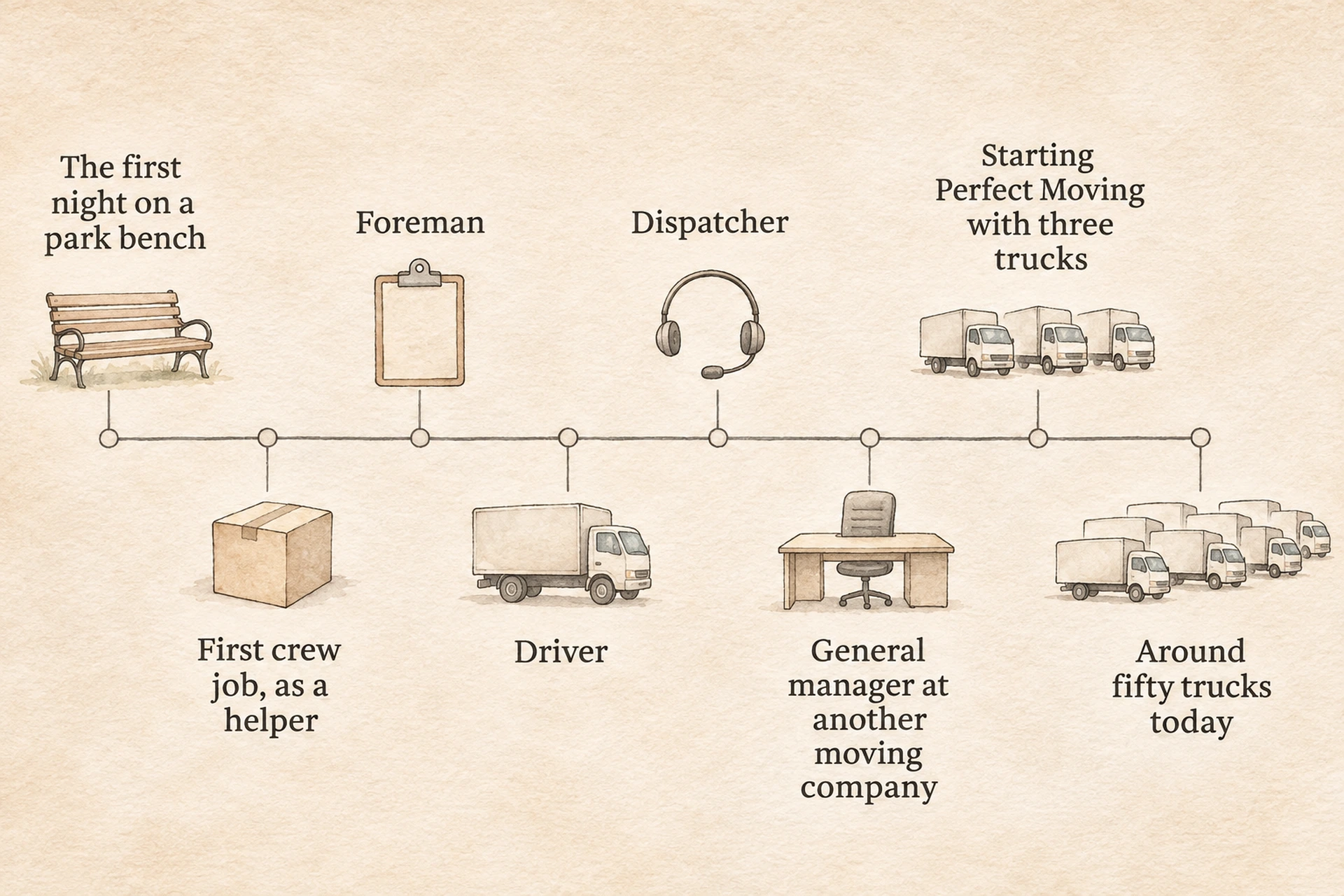
I did every job on the way up, in order: helper, then foreman running the job, then driver.
The driving started the way most things started then. A man we worked with did not want the next job. "If you feel like working, go ahead," he said, and then he left the truck in the middle of the highway and told me it was all mine.
The next job was still a job. Take the truck, sign out the equipment, get to the client, finish it without problems. I had never driven anything bigger than a Peugeot. I drove it.
"Once you're out in the field, there's nobody hanging over your head. Only one thing matters: finish the job without problems."
What I wanted in those years was not the money. I wanted us to be the number one team in the company: the fastest, the most work done, the best. Money comes and goes.
I made endless mistakes, and I still make them. My math has not changed: whatever it is, I will fix it, and then we move on. If you sit and wait for the mistake to mean something, you will not build anything.
It did not run upward in a straight line either. One day, around noon, close to home, I caught myself having made exactly four hundred dollars that day and not being happy at all. It read as a defeat, and I quit the same day. I had promised myself one thing first, so I stayed through July, August and September, because I knew what a worker is worth to a moving company in summer.
Then I was out of moving. I got a personal-training certificate, something that had pulled at me since I was small, and took a job at a gym on Fifth Avenue. Five clients, twice a week, ten hours of commitment. Everybody told me five was too many. For me it was close to standing still, and I like things moving forward.
So I went back to my old boss and asked whether there was anything in the office. He said there was nothing, and we left it there. Months later he called to say he had something, and I took it: I came back as a dispatcher and salesperson.
Dispatch is where the day changes shape. The teams get organized in the morning, before the trucks leave. From there it was operations manager, and then general manager at another moving company. From janitor to director, as I put it: I dealt with all of it, and I learned the biggest part of what I know there.
Starting Perfect Moving
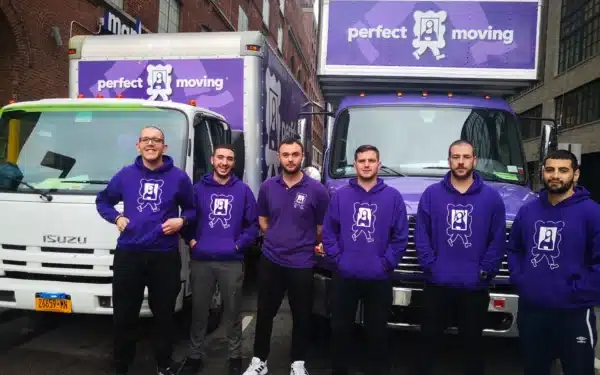
I started Perfect Moving & Storage with three trucks.
Leaving to do it was the easiest decision I have made. Running somebody else's large operation was like carrying a huge weight on your back, and starting my own was taking that off and putting on a backpack. The first idea was narrow: only the pricier jobs, high-end service, exclusively that. We started slowly and grew relatively fast.
There is a fair challenge to that view: a founder's experience is only part of the picture. Reliable service also depends on planning, clear communication, and practical systems. An owner's years on a truck do not, by themselves, tell a customer how a move will go.
The best evidence for that view is mine to hand over. Through COVID we went from twelve to thirteen trucks while other movers expanded fast. My instinct said take it slowly and do not rush in headlong, and I now call that caution one of my mistakes. The same judgment that came off the truck is what made me too careful with the business.
So my position is a modest one. Having done the work does not make an owner right. It makes him accountable to what the work actually asks, which is a different thing. The system still has to be built by somebody: I had to loosen things up and bring people into operations to run more than I could run myself, and we are at around fifty trucks today.
What the truck gave me was never a growth strategy. It was a set of values: what finishing a job means, and what is not acceptable to leave halfway.
What those years taught me
Working on trucks and in dispatch shaped how I think about moving. In the field, I learned the importance of following through. In dispatch, I learned how much preparation matters before a move begins.
Three values stayed with me: stability, careful judgment, and seeing a job through decently and honestly.
I brought those values with me when I started Perfect Moving & Storage. My priorities are careful handling, clear communication, and taking a thoughtful approach to the practical details of a move.
Two of the How a Move Should Work posts look at this from the customer's side: why how a company treats its crews reaches the customer and why years on the job do not become expertise on their own.
Here is a question you can ask any mover, including us: what practical experience informs your approach to moving, and how does that experience benefit the customer? Ask about the planning, communication, and care that will go into your move.
Rock's principles
Four principles that have guided me throughout my career.
- Finish what you start. To the end, decently and honestly, not left halfway.
- Do your best when nobody is watching. That line is not mine. A professor of mine used to say it.
- Whatever it is, I will fix it. The mistake is not the problem. Sitting still afterward is.
- Stability matters most. Before speed, before size.
"If you're chopping wood, chop all of it. Don't leave anything."
The values came from the truck
I can be wrong about plenty in running this company, and the COVID years say I have been. The values I work by were learned while I was carrying other people's furniture, and I still hold myself to them.
Start with an estimate
If you are planning a move, ask us for an estimate, and ask us the question above. Then decide what fits your move.
This article presents Perfect Moving & Storage founder and President Rock Katnic's account of his early years in moving and the principles that shaped his approach to the business. It reflects his personal experience and perspective.

- Deset dolara za četiri dana. Nikad nismo zvali kući., Gentle Provocation, Episode 08, a recorded interview in Serbian, for the account of my own path here and the lines quoted from me.
- Everything else in this piece is my own first-hand experience running moving operations in New York City.
- The truck count given here is as of November 2026 and is re-confirmed when it moves.
Rock Katnic, Author. In 2019 Rock Katnic started Perfect Moving & Storage, and he still runs it as President. He started at the ground level more than a decade ago as a moving helper and worked nearly every job on the way up, from driver to dispatcher to general manager. He writes about how New Yorkers can move without the usual chaos.
Eddie Torr, Editor. Eddie Torr is an AI content editor who acts as an independent check on quality and compliance; drafts go to him before a human review. He checks each claim against its approved source, holds the piece to the editorial standards, and returns a ranked verdict. He does not rewrite the copy and does not approve publishing; a human reviewer makes that call.
Reed Marks, Reviewer. Reed Marks is a senior editor. Over nine years he has worked in copy editing, content review, fact-checking, and editorial QA in many different fields, and his degrees are in Journalism (bachelor's) and Professional Writing (master's). He gives each piece its final human read before it publishes: he reviews the claims against the cited sources and checks that the writing is clean and on-brand for search.
Reviewed on this post: He checked that no year appears anywhere in the story, that no moving company other than Perfect Moving & Storage is named, and that no private person is named.