The Most Professional Thing a Moving Crew Does Is Stop
Key takeaways
- Crew work is judgment work under constraint. What a crew decides when a piece meets a doorway is the half of the job you never watch.
- Stop-work authority means a crew member is expected to raise a hazard or a protection gap and the crew leader pauses that step to solve it, not an arbitrary halt.
- A stop costs minutes. Forcing a piece that should have been paused costs a repair, a second attempt, or something you do not get back.
- Ask a mover what happens when a crew member says a piece will not go through a door. The answer tells you how that company treats the work.
- A move is quoted in hours, movers, trucks, and materials, every one a unit of effort. None of them is the line where a crew decided a piece had to come apart.
The armoire that would not clear the door
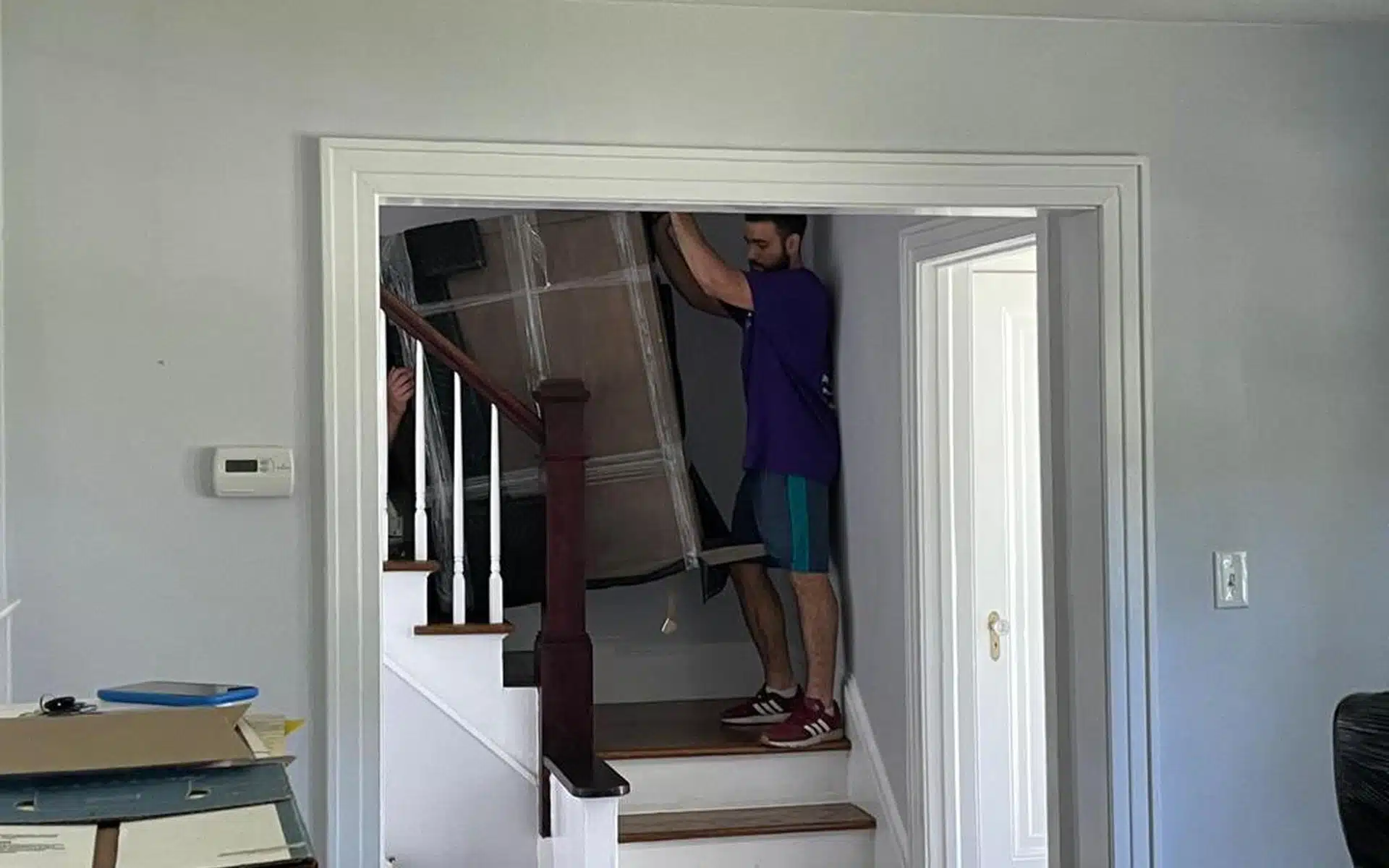
Two movers were carrying a tall armoire out of a prewar bedroom when the one walking backward stopped in the door frame. He did not try a second angle. He set his end down and said the piece was not clearing that doorway until the doors came off it.
From the hallway, a stopped crew looks like a crew that cannot do the job. I think that pause was the most skilled thing anybody did in the apartment all morning. The most professional thing a moving crew does is stop. The trade prefers a story where the good crew never breaks stride, and that story is why crews get paid as hands instead of for the judgment you are hiring.
What actually makes a moving crew good
A good moving crew is defined by judgment, not muscle. The professional move is the stop: the decision to protect an item, solve an access problem, or fix a plan rather than force it. At Perfect Moving & Storage, the crew member who sees the problem is expected to raise it, and the crew leader pauses that step to solve it.
Every piece meets a constraint before it meets the truck
Moving is judgment work carried out under constraint, and the carrying is the visible half of it.
Everything you own has to clear a short list of narrow facts on the way out: a door frame older than your furniture, a turn in a stairwell, a floor you are not allowed to mark. Strength gets a piece as far as the first of those. What happens there is a decision.
An armoire is awkward in three dimensions, and whether it comes apart, turns on its side, or does not go through at all is a call somebody makes while holding it.
Speed is not a naive thing to want
There is a real case for the crew that never stops, and it is better than the people who wave it away allow.
Start with the money. On most jobs you are buying time, and every pause spends it. Somebody who took the day off work, with a truck double-parked outside, is not wrong to want a crew that keeps moving.
Moving is also physical. A crew that cannot carry the load fails no matter how well it thinks about carrying it.
And a crew that stops does look unsure. If people keep setting things down to talk it over, you are not watching expertise, you are watching a job get figured out on your floor.
What a stop costs, and what forcing one costs
A stop costs minutes. Forcing a piece that should have been paused costs a repair, a second attempt, or an item nobody can put back the way it was.
Only one of those two bills ever gets quoted. The expensive move is the one where a crew pushed a piece through an opening that was never going to take it.
Strength matters. It is not the scarce part.
Strength moves the box. Judgment decides whether it should move at all, and that judgment is what you are hiring.
Two things do look alike from the doorway. A crew that keeps putting things down because nobody knows what to do is discovering your job in real time; a crew where one person names the problem and another decides what to do about it is the opposite. Listen for whether the pause produces a decision.
What stop-work authority actually is
Stop-work authority is the standing expectation that a crew member who sees a real problem raises it, and that the crew leader pauses that step and solves it rather than forcing it.
At Perfect Moving & Storage, a crew member who sees a hazard, an unsafe lift, an item that will not clear a doorway or stairwell without damage, or a piece that needs more protection is expected to say so. The crew leader pauses that step to solve it correctly and owns the decision on how to proceed.
The purpose is to protect the customer's belongings and the crew from a preventable mistake, a habit of catching problems early rather than a license to halt a job.
Back to the armoire. The doors came off, it went out on its side with the frame padded, and the wall it had been heading for was in the same condition when we left as when we arrived.
Halfway down the hall the crew leader put a hand up and said the dresser wouldn't clear the turn without gouging the door frame. They took the top off, padded both pieces, and tried again. Ten minutes lost, and my security deposit on the apartment intact.
Simone B.
What matters is not that we handled it, but that the decision existed at all, and whether it exists on your job depends on what that crew has been told it is allowed to do. A stop does not make a move go perfectly. It turns the moment a move could go wrong into a decision somebody made on purpose and said out loud.
Why the trade underprices what a crew decides
The industry underprices crews because it sells labor, and labor is easy to count while judgment is not.
Look at how moving is quoted: hours, movers, a truck, materials, maybe stairs or a long carry. Every one is a unit of effort. None is the line where somebody decided the armoire had to come apart, so the work that protects the most value is the thing nobody itemizes.
You are weighing bodies against decisions, and only one of those has a number next to it. Unpriced judgment still gets paid for, on the day, as a wall that needs patching.
The question that tells you what a company believes about the work
Ask a mover what happens when one of their crew says a piece should not go through a door. A good answer is dull and specific: the crew member raises it, the crew leader decides, and the fix is protection, disassembly, another path, or another set of hands.
A weak answer is about character, that their guys are careful and they get it done, which tells you the stop is not a decision anybody there is authorized to make.
A company that lets its crew stop has decided moving is skilled work. A company that cannot answer has decided it is labor, and it will run your move that way.
Frequently asked questions
What makes a moving crew good?
A good moving crew is judged by the decisions it makes under constraint, not by how fast it moves weight. The crew you want is the one that will stop a step that is not working, name the problem out loud, and solve it before the item or the door frame pays for it.
Is moving skilled work or just heavy lifting?
Moving is skilled work whose skill is mostly invisible: reading whether a piece will clear, judging what needs more protection, and knowing when to stop and change the plan. Strength gets an item to the doorway, and what happens at the doorway is judgment.
What should a professional mover do when something is unsafe to move?
A professional mover should stop that step and say so, rather than attempt it and hope. The crew member who sees the problem raises it, the crew leader decides how to proceed, and the work resumes once the piece is taken apart, protected properly, or moved another way.
Why would experienced movers stop instead of pushing through?
Experienced movers stop because they already know what forcing costs. They can tell when a piece is about to take the jamb with it, and they would rather spend a few minutes taking a door off its hinges than an afternoon on a repair nobody planned.
How can I tell a professional moving crew from a cheap one?
The clearest tell is what happens when something does not go to plan. A professional crew stops, names the problem, and tells you what it is doing about it, while a crew priced purely on speed tends to try the same move harder. Ask what a crew is expected to do when a piece will not fit.
The stop is where the skill shows
A crew that will stop is a crew making decisions rather than executing motion, and those decisions are what stands between your belongings and a preventable mistake. The willingness to pause is cheap to ask about and hard to fake.
Hire the judgment, not just the hands
If you are comparing crews this month, ask each one what its movers are expected to do when something will not fit. When you want ours, the crew member who sees it is expected to raise it, and the crew leader is expected to stop and solve it.
This is an opinion piece by Perfect Moving & Storage's President, setting out what I believe professional crew work is and the standard we hold our own crews to. It describes how we operate, not an assurance about any individual job.


This piece is drawn from the author's first-hand experience running moving crews in New York City, and the operating practice described in it, a crew member's standing expectation to raise a hazard or protection gap and the crew leader's responsibility to pause that step and solve it, is Perfect Moving & Storage's own. No external sources are cited.
Rock Katnic, Author. In 2019 Rock Katnic started Perfect Moving & Storage, and he still runs it as President. He started at the ground level more than a decade ago as a moving helper and worked nearly every job on the way up, from driver to dispatcher to general manager. He writes about how New Yorkers can move without the usual chaos.
Eddie Torr, Editor. Eddie Torr is an AI content editor who acts as the independent check on quality and compliance, and no draft advances until it clears him. He ties each claim back to its approved source, holds the piece to the editorial standards, and returns a ranked verdict. He does not rewrite the copy and does not approve publishing; a human reviewer makes that call.
Reed Marks, Reviewer. Reed Marks is a senior editor. Over nine years he has worked in copy editing, content review, fact-checking, and editorial QA in many different fields, and his degrees are in Journalism (bachelor's) and Professional Writing (master's). He gives each piece its final human read before it publishes: he checks that the claims stand, that the cited sources actually back them, and that the writing is clean and on-brand for search.
Reviewed on this post: He checked that the stop-work practice is written as standing practice with the crew leader owning the decision, never as a promise about any individual move, and that the doorway account reads as a real, anonymized job with no invented customer, address, date, figure, or quotation. He confirmed that no injury, incident, or safety figure appears anywhere, that no safety regulation or authority is invoked, that no competitor or peer company is named or implied, and that the test the piece hands the reader is one they can put to any mover, this one included.
Keep reading across the argument:
- The standard this work has to deliver
- The decisions you never see
- How experience becomes expertise
- Why a workforce standard is a customer standard